24 Jul 2014
WTI Swings as Crude Stockpiles at Cushing Decline; Brent Steady
West Texas Intermediate swung between gains and losses after U.S. government data showed crude supplies at the delivery point for New Yorkcontracts shrank to the lowest level since 2008. Brent was steady in London.
Futures were little changed in New York after rising 0.7 percent yesterday. Crude stockpiles at Cushing, Oklahoma, the biggest U.S. oil-storage hub, dropped by 1.45 million barrels to 18.8 million, the least since November 2008, according to an Energy Information Administration report. A measure of manufacturing in China, the world’s second-largest oil consumer, climbed to an 18-month high in July.
“The long-run story has not changed, global supply still looks healthy,” Barnabas Gan, an economist at Oversea-Chinese Banking Corp. inSingapore, said by phone today. “The global growth tailwinds are expected to continue, and that does give oil investors a reason to see higher prices in the short term.”
WTI for September delivery was at $102.86 a barrel on the New York Mercantile Exchange, down 26 cents, at 3:22 p.m. Singapore time. The contract increased 73 cents to $103.12 yesterday. The volume of all futures traded was 20 percent above the 100-day average. Prices have advanced 4.5 percent this year.
Brent for September settlement was 22 cents lower at $107.81 a barrel on the London-based ICE Futures Europe exchange. The European benchmark crude traded at a premium of $4.96 to WTI, compared with $4.91 yesterday.
U.S. crude inventories nationwide fell by almost 4 million barrels to 371.1 million in the week ended July 18, said the EIA, the Energy Department’s statistical arm. Supplies were down for a fourth week, the longest run of declines since January. They were forecast to decrease by 2.9 million, according to the median estimate in a Bloomberg News survey of nine analysts.
Gasoline stockpiles expanded by 3.38 million barrels, compared with a projected gain of 1 million. The peak U.S. driving season typically starts on Memorial Day, which came on May 26 this year, and runs through Labor Day on Sept. 1.
Distillate inventories, including heating oil and diesel, rose by 1.64 million barrels last week, the EIA report shows. An increase of 2 million was projected in the survey.
In China, a preliminary Purchasing Managers’ Index from HSBC Holdings Plc and Markit Economics was at 52, topping the median prediction of 51 in a separate Bloomberg survey and June’s final level of 50.7. Readings above 50 signal expansion.
The Asian country will account for about 11 percent of global oil demand this year, compared with 21 percent for the U.S., according to theInternational Energy Agency in Paris. - Bloomberg
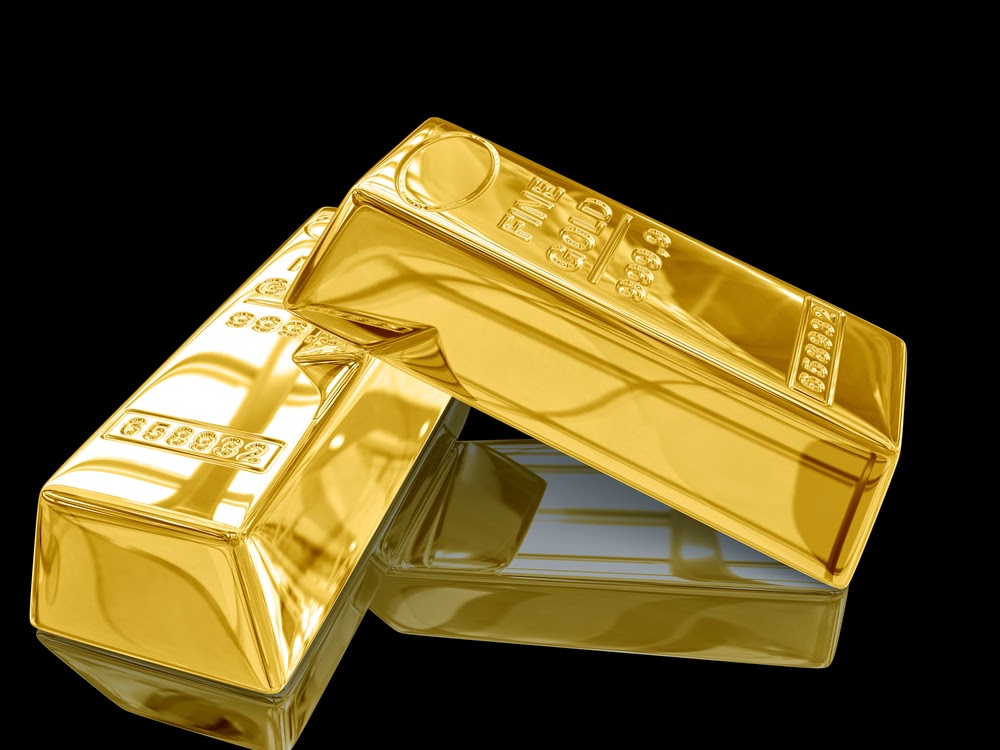
Gold Drops Below $1,300 as Stocks Rally Curbs Demand
Gold fell to the lowest level in a week as a rally in equities damped demand for an alternative investment amid concern that physical consumption is faltering.
Gold for immediate delivery lost as much as 0.7 percent to $1,294.98 an ounce, the lowest since July 16, before trading at $1,295.92 by 2:32 p.m. in Singapore, according to Bloomberg generic pricing. The metal has retreated for three days, and is on course for the first back-to-back weekly drop since May.
Bullion sank 28 percent last year on expectations the Federal Reserve will reduce stimulus. The Standard & Poor’s 500 index rose to a record yesterday as earnings of companies including Facebook Inc. topped estimates. Data yesterday showed gold consumption in China, which surpassed India as the largest user last year, fell 19 percent in the first half of 2014. The metal isn’t likely to get support from Indian demand as import restrictions remain unchanged, according to Commerzbank AG.
“The rally in U.S. equities continues to be a headwind for gold, despite safe-haven buying providing some support to prices,” Victor Thianpiriya, commodity strategist at Australia & New Zealand Banking Group Ltd., wrote in a note today.
Goldman Sachs Group Inc. reiterated a call for gold to drop to $1,050 by the end of 2014 as the U.S. economic recovery accelerates, analysts wrote in a report dated yesterday. The bank raised its long-term forecast 13 percent to the marginal cost support level of $1,200 in 2014-dollar terms.
Ukraine Jets
Gold has rebounded 7.8 percent this year in part as tensions in Ukraine and the Middle East fueled haven demand. The price failed to advance yesterday even as pro-Russian separatists shot down two Ukrainian fighter jets in the same eastern region where a Malaysian Air passenger jet was destroyed on July 17, the government said.
Gold for December delivery fell as much as 0.7 percent to $1,297 an ounce in New York, the lowest since July 16, before trading at $1,298. Holdings in the SPDR Gold Trust, the largest bullion-backed exchange-traded product, rose for a second day yesterday, data on its website showed.
Silver for immediate delivery declined 0.6 percent to $20.7998 an ounce. Spot platinum dropped as much as 0.7 percent to $1,471.89 an ounce, the lowest level since June 27, before trading at $1,472.29. Palladium decreased 0.3 percent to $869.21 an ounce.
Gold Is Tumbling While Copper Is Climbing
Gold is trading below $1300 and headed down this morning. Gold gave up $6.70 in the Asian session to trade at 1298.00 after touching a low of $1295.78. Silver followed alone declining by 152 points to trade at 20.843 and platinum touched 1479.65 duplicating gold’s movements. Asian equity markets rose on following upbeat economic data from China and as the region’s earnings season got under way. On Wednesday gold was holding its ground above $1,300 as violence deepened in the Middle East over the Gaza strip and as holdings in the top bullion-backed fund rose on safe-haven bids. Tensions remained high between Russia and the West over Ukraine. Kiev said two of its fighter jets were shot down over the rebel-held territory in eastern Ukraine on Wednesday, and the missiles that brought them down might have been fired from Russia.
SPDR Gold Trust, the world’s largest gold-backed exchange-traded fund, said its holdings rose 0.6 tonnes to 805.44 tonnes on Wednesday – a second straight day of increase. Gaza fighting raged on Wednesday, displacing thousands more Palestinians in the battered territory as U.S. Secretary of State John Kerry said efforts to secure a truce between Israel and Hamas had made some progress. Gold prices are expected to move in a range to down for the day over its fading safe haven appeal and poor physical demand.
China’s HSBC Flash Manufacturing Purchasing Managers’ Index (PMI) increased by 1.3 points to 52-mark in July from 50.7-level in the last month.
Base metals on traded lower yesterday on speculation that the rally in the prices of Zinc, Lead and Aluminium were excessive in absence of
enough fundamental demand. Also, investors were conscious ahead of manufacturing data from the US, Euro Zone and China due today. However, declining trend in LME inventories along with recovery in markets sentiments restricted sharp downside. Metals reversed their declines to gain after the release of Chinese PMI data, with copper climbing to trade at 3.231 up by 25 points and continuing to rise. - fxempire
Copper jumps 1% after China PMI hits 18-month high
Copper futures rallied to a more than one-week high on Thursday, as investors cheered better than expected manufacturing data out of China, the world’s largest consumer of the red metal.
On the Comex division of the New York Mercantile Exchange, copper for September delivery rose to a session high of $3.253 a pound, the most since July 16, before trimming gains to last trade at $3.248 during European morning hours, up 1.27%, or 4.1 cents.
Copper ended Wednesday’s session down 0.03%, or 0.1 cents, to settle at $3.207. Futures were likely to find support at $3.192, the low from July 23 and resistance at $3.255 a pound, the high from July 16.
Data released earlier showed that China’s HSBC Flash Purchasing Managers Index, the earliest indicator of the country's industrial activity, rose to an 18-month high of 52.0 in July from a final reading of 50.7 in June. Analysts had expected the index to rise to 51.0 this month.
Copper traders consider shifts in the HSBC PMI an indicator of China's copper demand, as the industrial metal is widely used by the sector.
The Asian nation is the world’s largest copper consumer, accounting for almost 40% of world consumption last year.
Elsewhere on the Comex, gold for August delivery shed 0.43%, or $5.60, to trade at $1,299.10 a troy ounce, while silver for September delivery dipped 0.41%, or 8.7 cents, to trade at $20.90 an ounce.
Later in the day, the U.S. was to produce data on unemployment claims, manufacturing activity and new home sales, amid ongoing speculation over when the Federal Reserve may start to raise interest rates. - investing.com
23 Jul 2014
Gold Steady-Firmer; Selling Interest Limited by Geopolitics
Kitco Metals Roundup: Gold prices are steady to modestly higher in early U.S. trading Wednesday. Even though there is less risk aversion in the market place at mid-week, the geopolitical events recently are keeping sellers of gold pensive. August Comex gold was last up $2.40 at $1,308.80 an ounce. Spot gold was last quoted steady at $1,308.00. December Comex silver last traded up $0.039 at $21.105 an ounce.
The gold market has so far shown a muted reaction to reports just out that two Ukrainian military jets have been shot down by Russian rebels. Still, there is a bit more investor and trader risk appetite in the market place at mid-week. But the Russia-Ukraine crisis and the Israel-Hamas fighting remain on the front burner of the market place. Many veteran market watchers are surprised there has not been greater risk aversion in the market place amid the heightened geopolitical tensions the past week, or even the past few months. One explanation could be that the industrialized world is so awash in cash following the major central banks of the world pumping monies into the world financial system the past few years. In other words, there’s more money in the world to be thrown at many markets. That certainly appears to be the case in the major world stock indexes, which are hovering near record or multi-year highs. The above postulation also suggests serious price inflation should occur at some point down the road. However, at present there is more concern about deflation, especially in the European Union.
Gold, U.S. Treasuries and the U.S. dollar are safe-haven assets that have been and likely will continue to be supported from the heightened world tensions. I suspect that for the near term, trading action in many markets will day to day swing from risk-on to risk-off, depending on the news headlines of that day.
Traders and investors are looking forward to the next piece of economic data coming out of China—preliminary manufacturing data on Thursday.
U.S. economic data due for release Wednesday is light and includes the weekly mortgage applications survey and the weekly DOE liquid energy stocks report.
Wyckoff’s Daily Risk Rating: 7.0 (Russia-Ukraine crisis and Irael-Hamas conflict are still front-burner matters for markets.)
(Wyckoff’s Daily Risk Rating is your way to quickly gauge investor risk appetite in the world market place each day. Each day I assess the “risk-on” or “risk-off” trader mentality in the market place with a numerical reading of 1 to 10, with 1 being least risk-averse (most risk-on) and 10 being the most risk-averse (risk-off), and 5 being neutral.
The London A.M. gold fix is $1,307.50 versus the previous P.M. fixing of $1,310.25.
Technically, August gold futures bulls and bears are on a level near-term technical playing field amid recent choppy trading. The gold bulls’ next upside near-term price breakout objective is to produce a close above solid technical resistance at the July high of $1,346.80. Bears' next near-term downside breakout price objective is closing prices below solid technical support at last week’s low of $1,292.60. First resistance is seen at Tuesday’s high of $1,316.80 and then at this week’s high of $1,319.00. First support is seen at the overnight low of $1,305.40 and then at this week’s low of $1,302.20.
December silver futures bulls have the slight near-term technical advantage amid choppy trading. Silver bulls’ next upside price breakout objective is closing prices above solid technical resistance at the July high of $21.67 an ounce. The next downside price breakout objective for the bears is closing prices below solid technical support at last week’s low of $20.70. First resistance is seen at this week’s high of $21.21 and then at $21.37. Next support is seen at this week’s low of $20.86 and then at $20.70. - kitco
Gold And Crude Oil Show Unusual Reverse Divergence
Gold is trading at 1307.90 this morning a bit stronger in the Asian market as traders bought up the cheaper commodity after its steady decline this week. Gold added $1.90 this morning while silver is down 21 points at 20.987 and platinum moved with gold to add $1.70 to trade at 1491.80. Silver was steady in early Wednesday trade after dipping overnight, but looked likely to hold above $1,300 an ounce as geopolitical tensions from crises in Ukraine and the Gaza strip brought safe-haven bids. Tensions eased on Tuesday after a train carrying the remains of some of the victims arrived in Ukrainian government territory and separatist leaders gave Malaysian authorities the aircraft’s flight recorders.
SPDR Gold Trust, the world’s largest gold-backed exchange-traded fund, said its holdings rose 1.5 tonnes to 804.84 tonnes yesterday. Gold is expected to drift lower in the last half of 2014 leading to a second annual decline in the average price as US monetary policy returns to normal and Asian demand weakens. Gold prices are expected to trade in the red today as its safe haven appeal has shifted to the US dollar.
Base metals are trading on the down side this morning with Copper flat at 3.206. Broad fundamentals still suggest downside as we are seeing subdued demand from major consumer China. Yesterday updated Chinese exports of refined copper rose to the highest since March last year with a very small base. Exports rose as probe into warehousing at Qingdao Port undermines the appeal of holding inventories of the metal tied to financing.
In a surprise divergence, gold eased, the US dollar gained and crude oil continued to climb. Crude normally will follow the track of gold during geopolitical tensions and as a rule when the US dollar climbs oil falls as it becomes more expensive to buy in US dollars. This morning crude gave back 36 cents to trade at 102.03 but still remains well over its suggested and average trading range even as geopolitical turmoil moved back from the brink on Tuesday. Traders will be closely monitoring todays US inventory report. U.S. crude dropped to around $102 a barrel in early Asian trade this morning, falling for a second consecutive session with oil supplies unaffected by continuing violence in Iraq, Ukraine and Gaza. The American Petroleum Institute (API) data released on Tuesday showed that U.S. crude inventories fell 555,000 barrels last week to 374.7 million. In Libya, oil production had fallen to around 450,000 barrels per day (bpd) as of Monday compared with 555,000 bpd on Thursday. The drop comes as a twin suicide bombing at a Libyan army base in Benghazi killed at least four solders. The European Union threatened Russia on Tuesday with harsher sanctions over Ukraine that could inflict wider damage on its economy following the downing of a Malaysian airliner, but it delayed action for a few days. Brent oil is flat this morning at 107.22
- FXEMPIRE
Stand-up traders fined for bending LME rules
The London Metal Exchange (LME) has fined almost all of the dealers buying and selling copper on its open-outcry floor a total of £13,750 and suspended one for standing up during a session.
Seven traders were fined £1,250 each for breaking a rule that states dealers must remain seated at all times while dealing on the LME floor, known as the ring, the bourse said in a notice dated last Friday.
Two traders were each given £2,500 fines because it was their second offence in three to six months, according to the notice.
There were 11 LME floor-trading companies when the rule was broken on July 11.
The LME, which accounts for more than 80% of industrial-metals futures trading, operates Europe’s last open-outcry floor. Ten companies are entitled to trade in the ring, where dealers sit on red leather sofas in a circle measuring 6m in diameter.
On the New York Mercantile Exchange, traders are in a pit with steps that allow them to see above each other. "The LME operates a ring, not a pit," Kathy Alys, an LME spokeswoman, said.
"Dealers that stand create an unfair advantage and might obstruct the view of other dealers and LME pricing committee members."
LME open outcry dates back to the 1800s, when merchants drew a circle in sawdust to trade tin and copper. While traders no longer wear top hats and tails, they still must comply with a formal dress code and rules, including buttoned shirts and a chewing gum ban. Breaches bring fines and penalty points, the accumulation of which results in temporary suspension.
The seven traders committing first offences were also given 20 disciplinary points apiece.
The two repeat offenders each received 40 points, and one of them was suspended because he had accumulated 60 points within three months.
Trading in the ring might be "unmanageable" and monitoring of trades more difficult when traders stood up, said Paddy Crabbe, a consultant and author of the Metals Trading Handbook. - bdlive
U.S. oil futures decline ahead of weekly supply data
West Texas Intermediate oil futures declined on Wednesday, as investors awaited the release of weekly supply data out of the U.S. later in the session to gauge the strength of oil demand from the world’s largest consumer.
On the New York Mercantile Exchange, U.S. crude oil for delivery in September dipped 0.41%, or 41 cents, to trade at $101.98 a barrel during European morning hours. Futures held in a tight range between $101.80 and $102.34 a barrel.
U.S. oil futures ended Tuesday’s session down 0.46%, or 47 cents, to settle at $102.39 a barrel.
New York-traded oil futures were likely to find support at $101.48 a barrel, the low from July 21 and resistance at $103.45 a barrel, the high from July 22.
Wednesday’s government report was expected to show that U.S. crude oil stockpiles fell by 2.8 million barrels last week, while gasoline stockpiles were forecast to increase by 1.3 million barrels.
After markets closed Tuesday, the American Petroleum Institute, an industry group, said that U.S. crude inventories fell by 555,000 barrels in the week ended July 18, compared to expectations for a decline of 2.6 million barrels.
The report also showed that gasoline stockpiles increased by 3.6 million barrels, while distillate stocks rose by 2.5 million barrels.
Elsewhere, on the ICE Futures Exchange in London, Brent oil for September delivery shed 0.13%, or 14 cents, to trade at $107.19 a barrel, as traders awaited new developments from Ukraine and the Middle East.
The European Union threatened Russia on Tuesday with harsher sanctions over Ukraine, while fighting in the Gaza Strip between Israeli security forces and Hamas militants continued. - investing.com
Oil smuggling finances Islamic State's new caliphate
Islamic State militants seized four small oilfields when they swept through north Iraq last month and are now selling crude oil and gasoline from them to finance their newly declared "caliphate".
Near the northern city of Mosul, the Islamic State has taken over the Najma and Qayara fields, while further south near Tikrit it overran the Himreen and Ajil fields during its two-day sweep through northern Iraq in mid-June.
The oilfields in Islamic State hands are modest compared to Iraq's giant fields near Kirkuk and Basra, which are under Kurdish and central government control. Most of the Islamic State-held oil wells - estimated by a Kurdish official to number around 80 - are sealed and not pumping.
But the monopoly over fuel in the territory it has captured gives the Islamic State leverage over other armed Sunni factions who could threaten its dominance in northern Iraq.
Iraqi officials say that in recent weeks the group has transported oil from Qayara to be processed by mobile refineries in Syria into low quality gasoil and gasoline, then brought back for sale in Mosul, a city of 2 million people.
Larger shipments of crude, some of them from Najma, are also sold via smugglers to Turkish traders at vastly discounted prices of around $25 per barrel, they said.
"We have confirmed reports showing that the Islamic State is shipping crude from Najma oilfield in Mosul into Syria to smuggle it to one of Syria's neighbors," said Husham al-Brefkani, head of Mosul provincial council's energy committee.
"The Islamic State is making multi-million dollar profits from this illegal trade."
Petrol stations in Mosul are now selling fuel supplied by traders working with the Islamic State, which charges either $1.0 or $1.5 a liter depending on quality - a huge increase on previous prices, one petrol station owner in the city said.
"The fuel is brought from Syria ... It’s triple the price before, but drivers have to buy it because subsidized government fuel was halted," he said.
Brefkani said the Islamic State was the sole sponsor of the imports from Syria, where the group also controls oilfields in the Syrian province of Deir al-Zor. "They use part of it for their vehicles and sell the rest to their traders in Mosul."
MILITANTS KEPT OILFIELD INTACT
Najma and Qayara had been operated by Angola's state-owned firm Sonangol, but it pulled out last year declaring force majeure amid rising development costs and security concerns over Sunni militants in the area, even before last month's assault.
Qayara, which has estimated reserves of 800 million barrels, had been producing 7,000 barrels per day of heavy crude before the Islamic State took over the field and a nearby 16,000 bpd refinery. Qayara refinery and second smaller plant at Kasak, northwest of Mosul, stopped operating when staff fled.
But Qayara oilfield itself has kept pumping after the militants asked Iraqi employees to stay at their posts, promising to protect them - as they have done at most oil facilities in order to maintain production.
Iraqi official gave the example of the battle to seize Baiji refinery in the north, Iraq’s largest, where the Islamic States and other insurgents have been trying since mid-June to control the site without damaging its facilities.
"(The Islamic State) were keen to keep energy installations inside Qayara intact. We did not realize why they did not destroy facilities, but a week later they started to fill the trucks with Qayara crude. They were planning from the beginning to profiteer the field," said an engineer who works at Qayara, speaking on condition of anonymity for fear of reprisals.
Iraqi government sources said it was hard to assess how much money the group makes from selling crude or the fuel refined in Syria as the number of trucks fluctuates daily. One source said that a separate - and now terminated - smuggling operation into the Kurdish enclave and into Iran generated nearly $1 million a day earlier this month.
One dealer and shipping company owner in Mosul said he buys 250-barrel truckloads of crude from the militants for $6,000.
"The next step depends on our cunning in dealing with the Turkish traders," he said.
FROM TAXES TO NYMEX?
As another revenue earner, the Islamic militant group levies taxes on all vehicles and trucks bringing goods into Mosul.
A large truck must pay $400, while small trucks are charged $100 and cars $50 if they are also carrying goods.
Ahmed Younis, a Baghdad expert on armed groups, said the Islamists were in effect establishing an economic state based on the increasing resources and infrastructure under their command.
Considering its spread across the Syria-Iraq border, its grip over oilfields there and its growing economic activity, the Islamic State will "transform into an economic giant with assets of billions of dollars," he said.
"In future, will they buy shares in NYMEX? Everything is possible," Younis said.
TIKRIT OILFIELDS
Further south Islamic State fighters control another two oilfields east of Tikrit, home town of Saddam Hussein.
One of them, Ajil, produced 25,000 bpd of crude that were shipped to the Kirkuk refinery and 150 million cubic feet of gas per day piped to the government-controlled Kirkuk power station.
The gas is still pumped - albeit at lower volume of about 100 million cubic feet daily - because, according to energy experts, Kirkuk power station supplies many towns in the region and the militants want to avoid energy shortages.
The militants are moving only small amounts of oil from Ajil because of fears that their primitive extraction techniques could ignite the gas, according to an engineer at the site.
The other small oilfield captured by the Islamic State is Himreen, with a capacity of 5,000-6,000 barrels per day from five operating oil wells.
"The militants brought technicians from outside Tikrit to deal with crude from Himreen and they started to dig up craters and siphon crude out of the wells using small water irrigation pumps," said an oil ministry employee working at the field.
An Iraqi security official said trucks used to smuggle crude from Ajil and Himreen into Iraqi Kurdistan and Iran. Kurdish peshmerga forces used to turn a blind eye.
But Iraqi national security forces as well as the peshmerga began to halt the trade on July 12, he said. The army used helicopters to bomb trucks heading east from Tikrit, while Kurdish security forces seized trucks with smuggled crude crossing into territories under their control.
"We have managed to destroy more than 50 trucks as of July 12," Iraqi counter-terrorism spokesman Sabah Nouri said. "Our helicopter strikes hit the smuggling process hard and cut a vital source of finance to the terrorists."
An oil ministry adviser estimated that in the first two weeks of July, before the operation was halted, the Islamic State made around $10 million - nearly $1 million a day.
The mayor of Tuz Khuramto, a town on the route between Tikrit, the Kurdish enclave and Iran, said the smuggling route had been shut down 10 days ago.
"Before that, between 30 to 60 trucks moved into the Kurdish region, but now we can say number is zero," Shallal Abdul said. - www.reuters.com
Gold prices gain in Asia as investors look for fresh cues on demand
Gold prices gained slightly in Asia on Wednesday as investors looked for fresh demand cues following U.S. data overnight that pointed to steady prices.
On the Comex division of the New York Mercantile Exchange, goldfutures for August delivery traded at $1,307.70 a troy ounce, up 0.11%, after hitting an overnight session low of $1,302.60 and off a high of $1,315.80.
Overnight, the Labor Department reported that the U.S. consumer price index rose 2.1% in June, unchanged from the previous month and in line with forecasts, which strengthened the dollar and weakened gold, as the two assets tend to trade inversely with one another.
On a month-over-month basis, U.S. consumer prices were up 0.3% after a 0.4% increase in May, also in line with expectations.
The data kept expectations firm that the days of loose monetary policies that have supported gold since the Great Recession in the U.S. are coming to an end.
Market talk points to the Fed ending its bond-buying program around October and then raising interest rates some time in 2015, though the length of time that will pass between those two policy moves remains up in the air.
June's core inflation rate, which excludes food and energy costs, rose by just 0.1% from May and 1.9% on year, slightly below market calls for 0.2% and 2.0% readings, respectively, which illustrated how gasoline was driving the CPI up, though markets viewed the numbers as fundamentally healthy anyway.
Elsewhere, the National Association of Realtors reported earlier that existing U.S. home sales rose 2.6% to 5.04 million units in June from 4.91 million in May, beating market forecasts for a 2.0% rise to 4.97 million units.
Silver for September delivery was down 0.01% at $21.005 a troy ounce. Copper futures for September delivery fell 0.05% at $3.203 a pound.
Subscribe to:
Posts (Atom)


.jpg)